EEG Ambient Synth
A generative synthesizer that transforms brainwave patterns into ambient soundscapes, exploring the direct link between mental states and music.
Overview
The EEG Ambient Synth is an experimental instrument that bridges neuroscience and music production. It takes brainwave frequency data, the electrical activity of the brain measured across different frequency bands, and maps it to synthesizer parameters in real-time.
The result is generative ambient music that directly reflects cognitive states: relaxation produces warm, slow-evolving pads; focus generates crisp, rhythmic textures; and sleep deprivation creates unstable, glitchy soundscapes.
This project combines my background in audio production (8+ years), cognitive science research, and product design into a unique creative tool.
The Concept
What if you could hear your thoughts? Not as words, but as music — an ambient soundscape that shifts and evolves with your mental state?
EEG Frequency Bands
The brain produces electrical activity at different frequencies. Delta is associated with deep sleep, Theta with drowsiness, Alpha with relaxation, Beta with alertness, Gamma with focus, and Complex with mixed states.
Sound Mapping
Each frequency band controls different synthesis parameters: sub-bass warmth, pad textures, rhythmic elements, and atmospheric effects. This creates a direct neural-to-audio pipeline.
Mental State Presets
The synth includes researched presets based on real EEG literature: Deep Focus, Creative Flow, Meditation, Sleep Deprived, Anxiety, and more — each with accurate band distributions.
Designing with Empathy
Traditional instruments demand years of dedicated practice. A piano requires precise finger coordination. A guitar needs callused fingertips and muscle memory. Even "accessible" digital tools like synthesizers, DAWs, and production software present steep learning curves filled with technical jargon about oscillators, filters, ADSR envelopes, and signal routing. For countless people, these barriers transform music from a universal human experience into an exclusive club they'll never join.
I designed the EEG Ambient Synth with these people in mind. Not as an afterthought or an accessibility checkbox, but as the primary consideration. What would it mean to create an instrument that truly anyone could play? One that doesn't punish trembling hands, doesn't require reading sheet music, doesn't demand thousands of hours of practice before producing something beautiful?
The answer: an instrument where the only input is your mind itself.
Accessibility as a Core Principle
Consider who this instrument serves. A person with cerebral palsy whose body doesn't allow the fine motor control needed for traditional instruments, but whose mind is as rich and musical as anyone's. An elderly individual with arthritis who had to give up the violin they played for decades, but who still feels music deeply. Someone with severe anxiety who finds traditional performance settings overwhelming, but who craves creative expression. A child with autism who struggles with the social dynamics of music lessons, but who finds peace in sound.
For all of these people, the EEG Ambient Synth offers something remarkable: the ability to create ambient soundscapes using nothing but their mental state. There are no wrong notes because there are no notes to hit. There's no performance anxiety because there's no performance to fail. The instrument meets each person exactly where they are, translating whatever mental state they're experiencing into valid, meaningful sound.
This isn't about lowering the bar. It's about recognizing that the bar was arbitrarily placed to begin with. Musical expression is a human birthright, not a skill to be earned.
A Meditative Process That Heals
Something profound happens when you hear your own mental state reflected back as sound. A feedback loop emerges. You influence the music, and the music influences you. This isn't passive listening; it's an active dialogue with your own consciousness, a conversation that most of us have never had the tools to have.
When the synth translates anxiety into unsettling, dissonant textures, you become aware of your state in a way that internal monologue fails to achieve. You hear your stress. And this awareness itself can trigger a shift. You take a breath, consciously relax, and the soundscape responds in real-time, warming and softening. You've just composed a piece of music through the simple act of self-regulation.
This meditative process is inherently healing. Unlike traditional meditation where you sit in silence hoping you're "doing it right," the EEG Synth provides immediate, non-judgmental feedback. You can literally hear yourself becoming calmer. The abstract concept of "finding inner peace" becomes tangible, audible, achievable.
Every mental state becomes valid artistic material. Restlessness isn't a failure, it's a texture. Sadness isn't wrong, it's a color. The wandering mind that frustrates traditional meditators here becomes a source of evolving, generative composition. You learn to observe your thoughts without judgment because the instrument treats all thoughts equally: as raw material for beauty.
Healing Through Creation
Music therapy has long recognized the healing power of sound, but typically positions the patient as a passive recipient, someone who listens to carefully selected tracks chosen by a professional. The EEG Ambient Synth inverts this paradigm. The user becomes both composer and audience, both therapist and patient, both the source and the receiver of healing sound.
There's deep psychological research supporting the therapeutic value of creative expression. But for many people, the technical barriers to creation prevent them from ever accessing these benefits. They consume art; they don't make it. The EEG Synth removes that barrier entirely. If you can think, you can create. If you can feel, you can compose.
Imagine guided meditation sessions where participants don't just visualize calm. They hear their progress toward it. Consider anxiety management tools that make the invisible visible, helping users recognize and interrupt stress patterns before they escalate. Picture neurofeedback training that feels less like clinical treatment and more like playing a beautiful, responsive instrument.
The EEG Ambient Synth sits at the intersection of art, science, and wellbeing. It represents a new category of tool that treats music not as product to be consumed, but as process to be experienced. In a world of endless content competing for our attention, it offers something increasingly rare: a reason to turn inward, and a gentle guide for the journey.
Key Features
Neural Oscilloscope
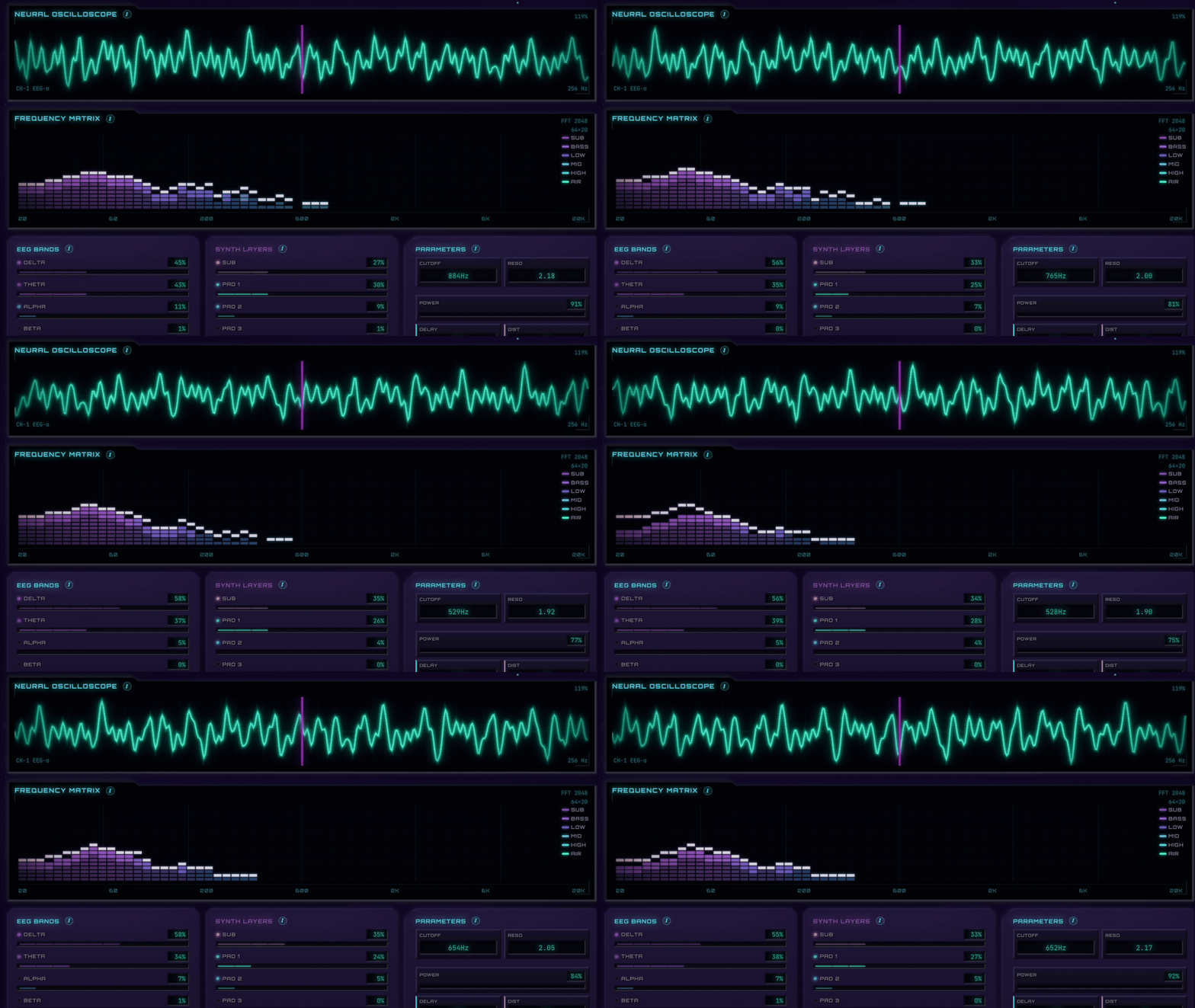
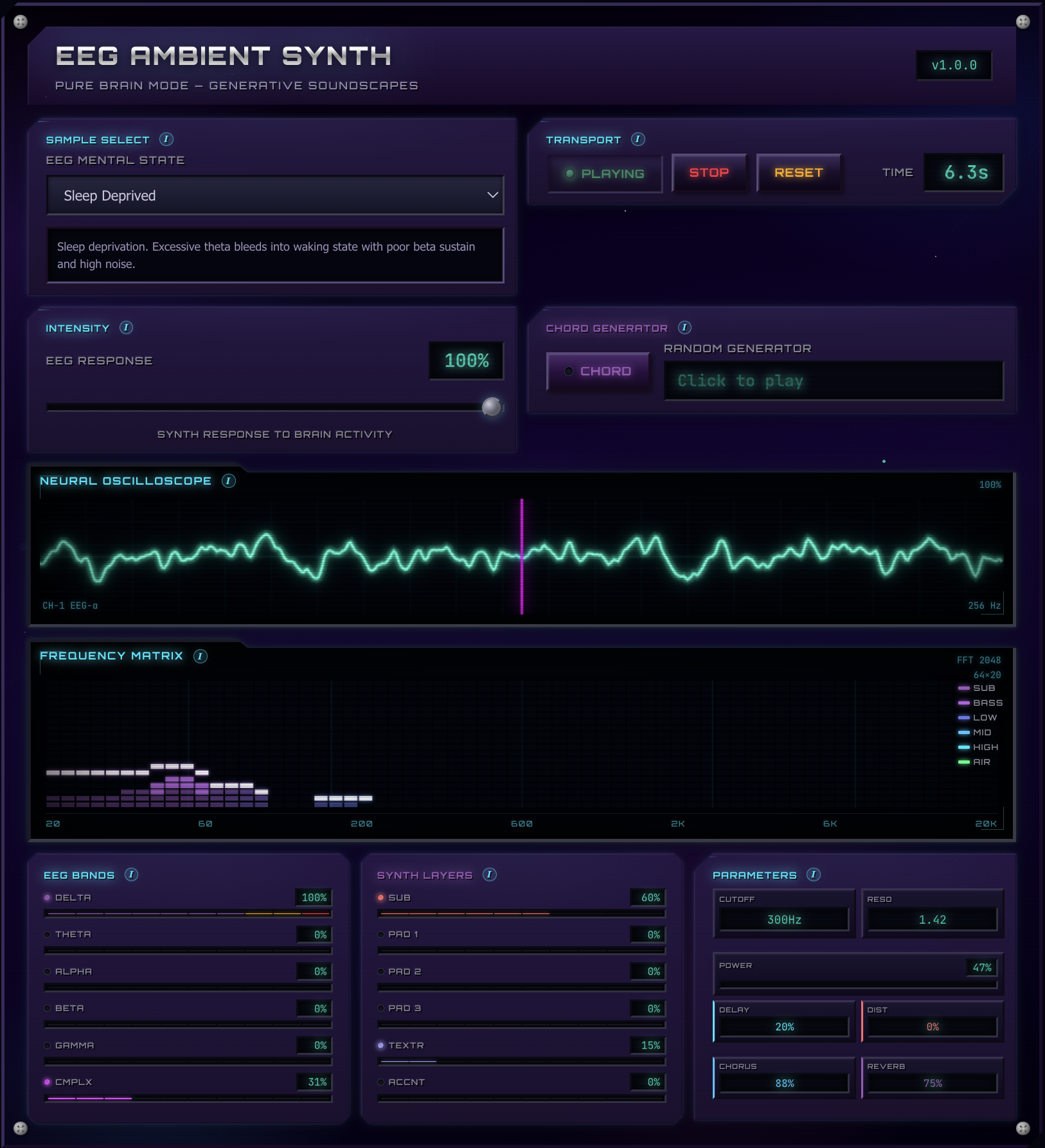
Real-time visualization of the combined EEG signal, showing the waveform that results from the current band configuration. Helps users understand what "brain activity" they're hearing.
Frequency Matrix
FFT-based spectrum analyzer showing the frequency content of the generated audio across 6 bands (Sub, Bass, Low, Mid, High, Air). Visual feedback for the sonic output.
6-Layer Synthesis
Independent control over Sub bass, three Pad layers, Texture, and Accent sounds. Each layer responds differently to EEG input, creating rich, evolving soundscapes.
Chord Generator
Built-in chord progression generator that creates harmonically interesting sequences. Can be triggered manually or set to generate randomly based on the current mental state.
Effects Chain
Full effects section with Delay, Distortion, Chorus, and Reverb — all with EEG-responsive parameters. Higher anxiety = more distortion; deeper relaxation = longer reverb tails.
Mental State Library
8+ researched presets based on actual EEG literature, including Deep Focus, Creative Flow, Meditation, Light Sleep, REM Sleep, Sleep Deprived, Anxiety, and Default states.
Technical Implementation
React + TypeScript
Component-based architecture for the UI, with TypeScript for type safety. Custom hooks manage audio context, EEG state, and real-time parameter updates.
Web Audio API + Tone.js
Low-level audio synthesis using the Web Audio API, with Tone.js providing higher-level abstractions for oscillators, filters, effects, and scheduling.
EEG Simulation
Currently uses simulated EEG data based on research literature. The architecture is designed to accept real EEG input from devices like Muse or OpenBCI in future versions.
Design Decisions
Retro Win32 VST Aesthetic
The interface pays homage to classic early-2000s VST plugins like Toxic Biohazard, Bazz Murda, and other iconic freeware synths. That era's bold neon-on-dark aesthetic, chunky panels, and unapologetically dense interfaces felt like peering into a mad scientist's laboratory. It's perfect for an instrument that reads your brain.
Real-Time Feedback
Every parameter change is immediately visible. The oscilloscope updates, the frequency matrix shifts, and the sound evolves. This creates a tight feedback loop that makes the brain-to-sound connection tangible.
Accessible Complexity
The preset system lets anyone generate interesting sounds immediately, while the detailed controls allow deep customization for experienced users. Progressive disclosure keeps the interface from overwhelming newcomers.
Future Development
Core Synthesis Engine
Built the audio engine with 6 synth layers and effects chain
EEG Simulation System
Created researched presets based on actual EEG literature
Visual Interface
Designed and built the oscilloscope, frequency matrix, and control panels
Real EEG Integration
Working on connecting to consumer EEG devices (Muse, OpenBCI)
MIDI Export
Allow users to export generated sequences to their DAW
Biofeedback Mode
Meditation training using audio feedback from real brainwaves
Interested in this project?
This synthesizer represents the intersection of my research in cognitive science, my passion for audio production, and my skills in product design. I'd love to discuss the technical details or potential applications.